
Views: 0 Author: Site Editor Publish Time: 2026-08-24 Origin: Site


Processing oversized steel blocks, ingots, and thick plates using inadequate cutting technology creates massive operational bottlenecks on the shop floor. Standard horizontal saws and thermal cutting methods struggle with deep cross-sections. They cause excessive material waste through wide kerf loss. You also face severe blade deflection, unwanted heat-affected zones (HAZ), and unacceptably slow cycle times. Thermal cutting often warps the material, forcing you to add secondary machining steps just to achieve a flat surface. Horizontal saws suffer from gravity pulling the blade sideways across wide spans, ruining dimensional accuracy. Evaluating the correct vertical plate band saw architecture is the only way to solve these issues. The right equipment ensures dimensional precision and maximizes carbide blade life. It allows you to scale heavy-duty plate processing without compromising facility throughput. A vertical cutting path changes the physics of the cut entirely. It leverages gravity for chip evacuation and coolant flow, keeping the cutting zone clear and cool.
Capacity Dictates Architecture: Throat depth, maximum cutting height, and table load capacity are the non-negotiable primary constraints when processing multi-ton steel slabs.
Rigidity Equals Yield: Heavy-duty cast or welded steel frames combined with high-tension blade guides are required to prevent blade deflection and ensure straight cuts in thick blocks.
Versatility Beyond Straight Cuts: Unlike horizontal models, vertical plate saws offer the flexibility for angled cuts, rough contouring, and specialized fabrication on massive workpieces.
Automation Drives ROI: Transitioning from manual feeds to CNC integration significantly reduces operator error, optimizes feed rates for hardened alloys, and lowers the overall cost-per-cut.
Material Handling is Integral: The saw's efficiency is directly tied to the integration of heavy-duty roller tables, hydraulic pushers, and crane clearances for safe slab manipulation.
Many operators mistakenly believe vertical saws are exclusively for thin materials or light-duty manual manipulation. We must explicitly contrast standard vertical contour saws with industrial vertical band saws for heavy-duty plate processing. Light-duty contour saws sit in woodshops or light fabrication corners. Industrial vertical models handle multi-ton steel blocks effortlessly. They feature massive columns, heavy-duty linear guideways, and hydraulic feed systems designed to push thousands of pounds of steel through a rigid cutting zone. These machines are built for the harshest fabrication environments.
The physics of a vertical blade path through deep cross-sections provides distinct advantages. Gravity assists the blade in a vertical setup. It pulls chips downward, resulting in superior chip evacuation. Horizontal saws often drag chips back through the cut, scoring the metal and dulling the blade teeth. When chips pack into the gullet of a horizontal blade, the friction spikes, heat builds up rapidly, and the blade eventually snaps. Gravity also pulls cutting fluid directly into the kerf. This ensures better coolant penetration compared to horizontal alternatives, where fluid often pools on top of the wide block and fails to reach the center of the cut. Better cooling prevents work-hardening in alloys like stainless steel and titanium.
Vertical architecture also offers unique flexibility. You gain the ability to perform angled cuts, rough contouring, and intricate shaping on thick plates. Horizontal saws generally only perform straight cross-cuts. Vertical machines allow you to rotate the workpiece or angle the cutting head. This flexibility proves essential for specialized fabrication and aerospace forging prep. You can rough out complex shapes before sending the block to a CNC mill, saving hundreds of hours of expensive milling time.
To understand the operational shift, consider these specific advantages of vertical cutting paths:
Continuous chip evacuation prevents gullet packing in deep cuts.
Coolant flows naturally to the hottest part of the cutting zone.
Blade deflection is minimized because the beam strength of the blade aligns with the feed direction.
Operators have a clearer line of sight to the cutting interface.
The footprint often requires less horizontal floor space for the machine itself.
Minimizing kerf loss on high-value alloys maximizes material yield. Cutting tool steel, titanium, or Inconel requires precision to avoid turning expensive material into scrap chips. A thermal cutting torch might leave a half-inch kerf and a hardened edge that ruins milling cutters later. A precision vertical band saw leaves a narrow kerf, often under an eighth of an inch. Over hundreds of cuts, this narrow kerf saves tons of raw material. You retain more usable metal for your final products, directly improving the yield per raw ingot.
Achieving tight squareness and parallelism tolerances straight off the saw is equally important. Precise cuts reduce or completely eliminate secondary milling and machining operations. When a saw cuts perfectly square, you do not need to face the block on a large horizontal boring mill just to establish a datum edge. The block moves directly to the next production stage. This immediate readiness accelerates your entire manufacturing workflow and reduces labor hours per part. If you cut a block of P20 tool steel for a mold base, starting with a perfectly square block saves the machinist hours of setup and squaring time.
Evaluate throat depth and maximum cutting height against your largest expected slab dimensions. Factor in future production goals to avoid outgrowing the machine. Throat depth determines how wide of a plate you can split down the middle. Cutting height dictates the maximum thickness the guides can clear. If you process 40-inch thick forging blocks, you need a machine specifically engineered with the column height and guide arm travel to accommodate that mass. Pushing a machine beyond its rated capacity leads to severe deflection and broken equipment.
Machine weight and frame construction dictate cutting performance. Heavy-welded steel or cast iron frames dampen harmonic vibration during prolonged, heavy-duty cuts. Vibration destroys blades and ruins surface finishes. When cutting thick steel, the blade teeth generate intense harmonic frequencies. A lightweight frame acts like a tuning fork, amplifying these vibrations until the blade chatters and snaps. Massive, rigid frames absorb this energy, keeping the blade tracking perfectly straight through the entire depth of the block. Dual-column designs offer superior torsional rigidity compared to single-pillar setups.
Evaluate the viability of sturdy, retrofitted used frames versus investing in new, purpose-built heavy-duty architecture. Older cast iron frames offer excellent vibration dampening. However, retrofitting them with modern hydraulics and controls often introduces integration headaches. New frames provide better long-term rigidity for modern carbide blades. They incorporate modern finite element analysis (FEA) in their design, placing steel exactly where the cutting forces demand it most. Modern frames also account for the massive tension required by wide carbide blades, preventing the frame from bowing under pressure.
Select appropriate blade widths and thicknesses to withstand high feed pressures without bowing. Large blocks typically require blades ranging from 1.5 inches to 3 inches or wider. A wider blade provides higher beam strength. This prevents the blade from wandering off-center when cutting through dense material. Thick blades also withstand the immense tension required to keep the cutting edge straight across a massive vertical span. Band wheel diameter must match the blade thickness; running a thick blade on small wheels causes premature fatigue cracking in the blade backing.
Tooth pitch (TPI) and geometry selection play a major role in cutting efficiency. Fine-tooth blades suit thinner profiles. Deep steel blocks demand aggressive, variable-pitch carbide blades to prevent chip packing. If the gullet between the teeth fills with chips before exiting the cut, the blade will stall or break. Variable pitch blades, such as a 0.8/1.2 or 1.2/1.6 TPI ratio, disrupt harmonic vibrations and provide large gullets to carry thick chips out of deep cuts efficiently. Carbide-tipped teeth handle the heat and abrasion of high-nickel alloys far better than standard bi-metal blades.
Evaluate Variable Frequency Drives (VFD), gearbox torque ratings, and horsepower requirements. Continuous heavy-duty cutting requires robust drive systems to maintain constant band speed under load. A VFD allows you to dial in the exact surface feet per minute (SFPM) required for specific alloys. High-torque gearboxes ensure the blade does not stall when it hits a hard spot in a massive steel ingot. Direct-drive systems eliminate belt slippage during aggressive feeding, transferring maximum power directly to the cutting interface.
Compare fixed-table configurations with heavy-duty moving-table designs. Fixed tables require the operator or a basic feeder to manipulate the workpiece. This works for lighter plates but fails completely on multi-ton blocks. Moving-table designs are engineered specifically for feeding massive blocks into the blade smoothly. These tables ride on precision linear guideways driven by heavy-duty ball screws or hydraulic cylinders. The guideways must be protected by heavy-duty wipers to prevent steel chips from destroying the bearings.
Assess weight capacities and T-slot configurations for secure fixturing. The table must support the physical weight of the steel block without deflecting. T-slots allow operators to bolt down heavy clamps and custom fixtures. Securing the block prevents it from shifting during the cut, which would instantly snap a wide carbide blade. Proper fixturing guarantees the parallelism of the final cut. If the block shifts even a fraction of an inch during a 30-inch deep cut, the blade will bind and shatter.
Integrated hydraulic material pushers are absolutely necessary for safe handling of heavy slabs. Operators cannot manually push a 10,000-pound steel block. Hydraulic pushers align the material squarely against the fences. They provide controlled, steady pressure to position the block for the next cut. This automation removes operators from the danger zone and prevents crushing injuries during material staging.
System Architecture Comparison
| Feature Category | Fixed Table Architecture | Moving Table Architecture |
|---|---|---|
| Workpiece Manipulation | Manual or external feeder required | Integrated automated sliding table |
| Weight Capacity | Limited to lighter plates and blocks | Engineered for multi-ton heavy slabs |
| Feed Control | Operator dependent | Precision ball screw or hydraulic drive |
| Fixturing Options | Basic clamping | Heavy-duty T-slots and hydraulic vises |
| Primary Use Case | Contouring and light fabrication | Deep cross-section block slicing |
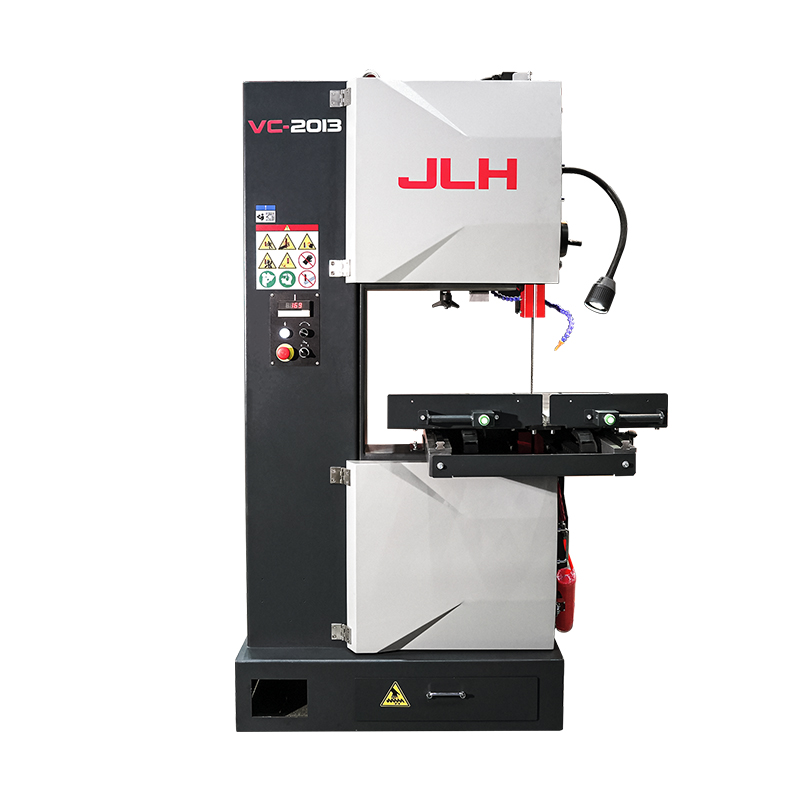
A traditional vertical plate band saw fits specific operational profiles perfectly. These models serve low-volume, high-mix job shops requiring versatility. They handle different plate sizes, angled cuts, and custom fabrication tasks daily. Operators can quickly set up a one-off cut without programming a complex interface. The machine provides robust cutting power while remaining accessible for varied, unpredictable daily workloads. You can switch from cutting a 10-inch block of aluminum to a 5-inch plate of mild steel with minimal setup time.
The trade-offs involve balancing a lower initial capital expenditure against a higher reliance on operator skill. Operators must regulate feed rates manually based on the sound and feel of the cut. They manage manual table manipulation and must measure carefully to ensure dimensional accuracy. An experienced operator can achieve excellent results, but a novice might push the blade too hard, causing premature wear or crooked cuts. Consistency relies heavily on the human element, which introduces variability across different shifts.
High-production steel service centers require advanced, repeatable solutions. A CNC vertical plate band saw excels in automated manufacturing facilities processing thick stock. They are ideal for aerospace forging prep and high-volume block processing. The CNC controller takes over the complex variables of the cutting process. Operators simply load the material, select the program, and let the machine execute the cuts. The machine handles the heavy lifting, ensuring the feed rate matches the material density perfectly.
Programmable feed rates and automatic blade deflection monitoring ensure consistent cuts. If the system detects the blade wandering, it automatically slows the feed rate to bring the cut back to a perfectly straight line. Precise length indexing and recipe storage allow for highly repeatable cutting of specific steel grades. You can save the exact speeds and feeds for 4140 steel. The next time that material hits the saw, the operator recalls the recipe, guaranteeing identical performance every time. This eliminates guesswork and protects your tooling investment.
Rigid hydraulic blade guides and optimal tensioning directly extend the lifespan of expensive bi-metal and carbide-tipped blades. Proper tension prevents micro-fractures in the blade backing. Hydraulic tensioners maintain exact pressure even as the blade heats up and stretches during a long cut. Solid carbide guide pads keep the blade perfectly vertical, preventing the twisting forces that strip teeth from the band. Spring-loaded tensioners often fail to maintain consistent pressure during heavy cuts, leading to blade wander and premature failure.
Shift your purchasing mindset from the initial machine price to calculating the long-term cost-per-cut and material savings. Extended blade life drastically reduces operational expenses over months of continuous cutting. A machine that tracks perfectly extends the life of a carbide blade significantly. Furthermore, the material saved by a narrow, precise kerf adds up quickly. Saving a quarter-inch of high-nickel alloy on every cut yields massive financial returns over a single production year. You also save money on coolant by using programmable mist systems that apply lubrication exactly where it is needed.
Analyze the true floor space required for the installation. Include the machine footprint, infeed staging areas, outfeed zones, and crane access paths. Massive steel blocks require significant maneuvering room. You cannot place a heavy-duty saw in a tight corner. Forklifts and overhead cranes need clear paths to load raw blocks and remove finished slabs safely without bottlenecking other factory operations. Consider the swing radius of the crane and the turning radius of the forklift when mapping out the installation site.
Evaluate power consumption and pneumatic requirements. Industrial saws draw significant amperage, especially during startup and heavy cutting. Verify your facility can supply the required three-phase power. High-volume coolant management and filtration systems demand dedicated space and maintenance access. Cutting thick blocks generates massive amounts of chips and requires high-pressure coolant. You need room for chip conveyors, coolant reservoirs, and filtration units to keep the fluid clean and effective. Dirty coolant destroys pump seals and degrades cutting performance rapidly.
Heavy-duty saws require specialized foundations to maintain calibration and prevent settling. Review concrete depth, reinforcement, and leveling requirements before delivery. Standard factory floors often crack under the concentrated weight of a multi-ton saw and a massive steel block. You may need to excavate the floor, pour a reinforced concrete pad, and use epoxy grout to secure the machine leveling pads permanently. Core drilling and setting heavy-duty anchor bolts ensure the machine does not shift during aggressive cutting cycles.
Rigging multi-ton machinery into existing operational facilities presents logistical challenges. Plan the moving path, verify door clearances, and ensure overhead cranes can handle the lifting weight. Coordinate with professional machinery riggers. They use specialized skates, jacks, and lifting beams to position the saw without twisting the frame. A twisted frame ruins the machine's geometric accuracy before it even makes its first cut. Ensure the riggers understand the specific lifting points designated by the manufacturer to avoid damaging sensitive linear guideways.
Transitioning operators from horizontal setups to vertical plate processing requires structured training. Automated feed systems operate differently than manual manipulation. Operators must learn to trust the CNC controls rather than forcing the cut manually. Training should cover blade selection, feed rate optimization, and the interpretation of blade deflection monitors. Proper training prevents expensive machine crashes during the first few weeks of operation. Operators need to understand how to read the chips; the color and shape of the steel chip tell you exactly how the blade is performing.
Ensure compliance with safety standards through laser guarding and interlocked enclosures. Moving massive steel blocks poses severe pinch-point hazards. Light curtains and laser scanners detect operator presence and halt the machine instantly if someone breaches the safety zone. Automated chip conveyor systems minimize manual intervention. They pull sharp, hot chips out of the cutting zone automatically, keeping operators away from moving parts and hazardous debris. Safety interlocks on the blade wheel doors prevent the machine from starting while exposed, protecting workers from band breakage.
Conduct a time-study on current cutting methods to identify exact cycle time bottlenecks.
Calculate potential kerf and machining savings based on the precise cuts a vertical saw delivers.
Request a documented test cut from manufacturers using your specific steel grade.
Audit your facility floor space to ensure adequate clearance for overhead cranes and material staging.
A: Industrial vertical plate saws can cut steel blocks ranging from 20 inches to over 60 inches thick, depending on the specific machine's throat depth and guide arm height. Heavy-duty models are custom-engineered to handle massive forging blocks and ingots.
A: Vertical saws orient the blade straight up and down, allowing gravity to pull chips and coolant through the deep cut. Horizontal saws drag the blade across the top of the material, which often leads to poor chip evacuation, coolant starvation, and severe blade deflection on wide blocks.
A: Yes. Unlike horizontal saws limited to straight cross-cuts, many vertical models feature rotating cutting heads or movable tables. This allows operators to perform angled cuts, rough out complex shapes, and execute specialized contouring on massive workpieces.
A: Thick steel slabs require wide blades for beam strength. Carbide-tipped blades with an aggressive, variable tooth pitch are best. Large gullets prevent chip packing in deep cuts.
A: A CNC model automates feed rates, monitors blade deflection, and stores material-specific cutting recipes. This eliminates operator error, maximizes blade life, and ensures highly repeatable, precise cuts for high-volume production facilities.
A: Material loading requires overhead cranes or heavy-duty forklifts to place the block onto integrated roller tables. Hydraulic material pushers and automated sliding tables then safely maneuver the multi-ton block into the cutting zone without manual pushing.
A: Industrial models require specialized, reinforced concrete foundations to support the combined weight of the machine and massive steel blocks. Proper leveling and epoxy grouting prevent the machine from settling, ensuring long-term cutting accuracy.


