
Views: 0 Author: Site Editor Publish Time: 2026-08-21 Origin: Site


Bottlenecking a fabrication shop or manufacturing floor with mismatched cutting equipment carries a heavy operational cost. Misaligning saw capabilities with material types, stock dimensions, and production volume leads to accelerated blade wear, excessive operator fatigue, and reduced throughput. When operators force thick, hardened steel through a machine designed for light contouring, blades strip and cycle times plummet. Conversely, using a massive automated cutoff saw for intricate sheet metal work wastes floor space and limits fabrication flexibility.
Choosing between vertical and horizontal configurations requires a strict evaluation of shop floor realities. You must analyze material hardness, stock dimensions, and specific fabrication workflows rather than relying on generalized tool recommendations. Every shop demands a specific approach to cutting mechanics. Understanding how blade orientation and feed pressure interact with your primary materials ensures you deploy the right machine for the job.
Production vs. Precision: Horizontal machines excel at high-volume, unattended cutoffs of thick stock, while vertical machines provide the manual control required for complex shapes and contouring.
Material Handling Dynamics: Horizontal saws hold the workpiece completely steady while the blade moves through it; vertical saws require the operator to move the workpiece through a stationary blade path, allowing for creative shaping.
Material Hardness Suitability: Horizontal bandsaws are engineered to efficiently slice through harder metals like stainless steel, whereas vertical bandsaws are generally more ideal for softer metals, mild structural steel, and thin sheet metal.
Cost of Operation: Unattended horizontal cutting reduces direct labor costs per cut, whereas vertical cutting requires continuous operator engagement but offers superior versatility for custom fabrication.
Space and Scalability: Evaluating footprint, material infeed/outfeed requirements, and power consumption is critical for integrating either machine into an existing shop layout.
Auditing your shop's primary materials establishes the baseline for equipment selection. You must categorize your daily intake. Structural steel, stainless alloys, aluminum billets, and thin sheet metal all dictate different machining approaches. Harder metals require aggressive, consistent feed rates. If a blade rubs against 304 stainless steel without cutting, the material work-hardens. This ruins the blade instantly.
To properly evaluate your material profile, execute this specific audit on your floor:
Categorize your daily intake by material grade and shape.
Measure the maximum cross-section of your largest common stock.
Identify the percentage of solid billets versus thin-walled tubing.
Determine the frequency of alloy changeovers during a standard shift.
Horizontal machines apply consistent mechanical feed pressure. Gravity or hydraulic cylinders pull the blade down through the cut. This constant force allows the teeth to penetrate harder metals like stainless steel and hardened alloys efficiently. The machine does the heavy lifting. In contrast, vertical band saws excel when processing softer metals and mild structural steel. The operator manually dictates the feed rate. This manual control works perfectly for aluminum or thin-gauge steel but fails against dense tool steel.
You must define the physical threshold of your stock. Manual feeding becomes impractical when stock thickness, length, and weight exceed an operator's physical capacity. Pushing a heavy steel plate across a table causes fatigue and compromises safety. Once a workpiece requires a forklift or overhead crane to position, manual feeding on a vertical table loses all efficiency.
High-mix, low-volume environments demand versatility. Prototyping shops, tool and die makers, and custom fabrication bays process different parts every day. Operators need a machine that adapts instantly to new shapes. Complex geometries require manual manipulation. In these settings, the ability to cut internal radii or notch irregular parts outweighs raw cutting speed. You might cut a piece of angle iron, then immediately switch to contouring a piece of flat bar.
Low-mix, high-volume environments operate on strict cycle times. Production runs and heavy structural fabrication require repetitive, identical cuts. Operators load long lengths of bar stock or pipe and need dozens of identical pieces cut to tight tolerances. Cycle times and operator dependency dictate the baseline requirements here. A machine that requires an operator to stand and push material through every single cut destroys production efficiency in a high-volume setting. You need a system where the operator loads the material, sets the stop, and walks away to perform other tasks while the machine works.
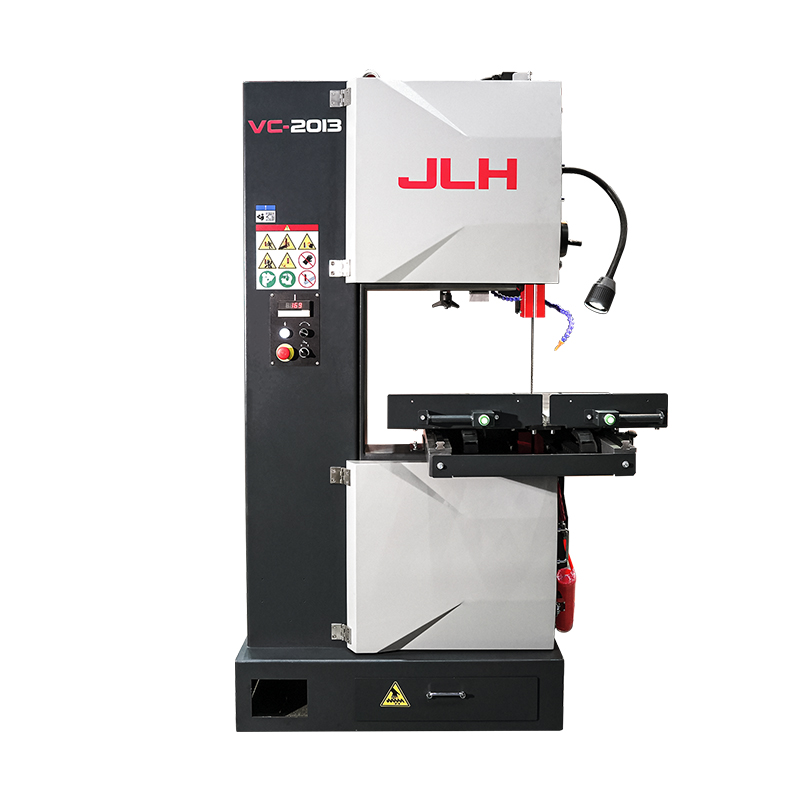
The defining characteristic of these machines is the vertical blade orientation. The cutting head remains entirely stationary. The blade travels downward through the worktable. This table supports the workpiece and often tilts on a heavy-duty trunnion to accommodate angled cuts. Operators slide the material across the flat surface, steering it directly into the blade path.
Blade guide placement determines cut accuracy. Upper and lower guides, typically utilizing carbide blocks or roller bearings, keep the blade tracking straight under manual pressure. Operators adjust the upper guide post to sit just above the workpiece. This minimizes blade deflection and prevents the blade from twisting out of the cut. Most industrial vertical band saw machines rely on manual feeding. The operator physically pushes the metal. Some heavy-duty models feature power-assist tables. These tables use hydraulic cylinders or mechanical drives to push heavy plates into the blade, reducing physical strain and providing a more consistent feed rate than humanly possible.
Custom fabrication relies heavily on the vertical contour saw. This machine handles internal cuts, radius cutting, and shaping irregular parts. Operators drill a pilot hole in the workpiece. They cut the bandsaw blade, thread it through the hole, and weld it back together using an integrated blade welder located on the machine column. After grinding the weld flush, they tension the blade and execute precise internal cutouts impossible on other machinery.
Vertical orientation provides a distinct advantage for gang cutting thin sheet metal. Operators stack multiple sheets, clamp them securely, and cut complex profiles in a single pass. Notching structural components also proves highly efficient. You can manipulate an angle iron or channel to cut specific notches for weld prep. Processing softer metals happens with high flexibility, allowing rapid transitions between different part shapes without complex fixturing or setup changes.
Manual feeding exacts a physical toll. Operators must constantly push and guide heavy materials. This continuous exertion leads to fatigue. Fatigued operators make mistakes, feed material unevenly, or risk injury. The human element introduces variable feed pressure. This variability directly impacts cut quality and blade longevity. When an operator pushes too hard, the gullets of the blade fill with chips, causing the blade to wander.
Vertical configurations struggle severely with thick, solid bar stock or hardened steel billets. They are highly impractical for these applications. Inconsistent feed pressure prevents the teeth from maintaining a proper chip load. The blade deflects under heavy manual pushing. This causes crooked cuts and rapid tooth wear. Without the mechanical downforce of a hydraulic system, cutting a solid six-inch steel round on a vertical table wastes time and destroys tooling.
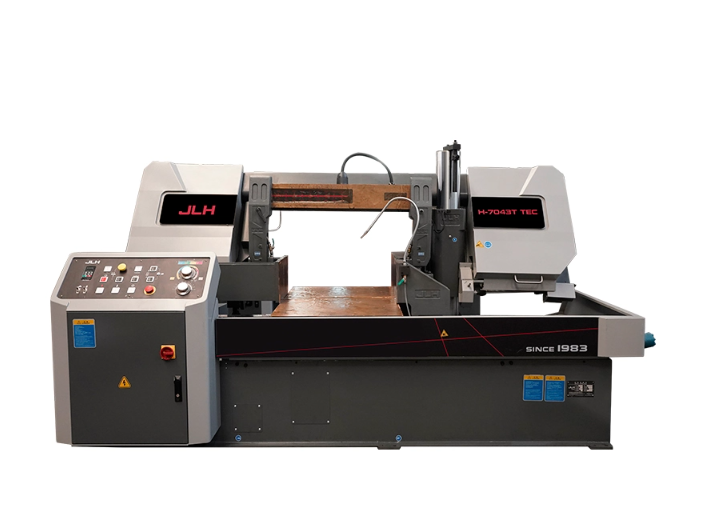
Horizontal machines operate on a fundamentally different principle. The workpiece remains completely stationary. The cutting head descends into the material. Manufacturers build these saws using either a horizontal pivot design or a dual-column design. Pivot saws function like a scissor, dropping the head from a rear hinge. Dual-column saws lower the massive cutting head down two precision-ground linear rails. This dual-column approach offers unmatched rigidity for massive structural cuts, eliminating the vibration that destroys carbide-tipped blades.
Feed systems dictate performance. Gravity feed systems use the heavy weight of the cast iron head to pull the blade through the metal, regulated by a hydraulic dashpot. True hydraulic downfeed systems offer precise control over this descent. Operators dial in the exact feed rate and cutting pressure. Automated material indexing systems take this further. They use hydraulic shuttles or servo-driven rollers to automatically advance long stock, clamp it, and initiate the next cut without human intervention.
Efficiency defines horizontal band saws when squaring off pipe, heavy square tubing, and solid bar stock. Processing long stock happens rapidly. You load a twenty-foot length of steel, set the stop, and let the machine work. The heavy cast iron vises clamp the material dead-center. This rigid fixturing maintains tight tolerances on repetitive production cuts, ensuring every piece meets spec for the welding department.
Bundle cutting capabilities maximize throughput. Operators stack multiple pipes or tubes into a hex or square bundle. Specialized overhead clamps secure the bundle tightly, preventing the inner tubes from spinning. The saw slices through dozens of pieces simultaneously. This workflow dominates structural steel fabrication shops where raw material breakdown forms the core bottleneck.
These machines face a strict limitation to straight or mitered cutoffs. They cannot perform contouring. Creative shaping remains impossible. You cannot execute intricate internal cuts. The blade travels in a straight line, severing the material entirely. If a part requires a curved profile or a complex notch, a horizontal machine cannot complete the job.
Footprint presents another significant challenge. The machine itself takes up substantial space. However, you must also factor in the roller tables required for long stock infeed and outfeed. A saw cutting twenty-foot lengths requires at least forty feet of linear floor space. This massive footprint dominates shop layouts and requires careful planning for material flow. You cannot tuck a large horizontal saw into a tight corner; it requires dedicated real estate.
Feed pressure dictates cutting success. Hydraulic and gravity systems on horizontal machines deliver absolute consistency. The blade engages the material with a steady, calculated force. This constant pressure ensures each tooth takes a uniform chip. Variable manual pressure on a vertical machine fluctuates constantly. An operator pushes hard, gets tired, and eases off. This fluctuation changes the chip load second by second.
Feed consistency impacts blade life directly. When transitioning between soft and hard metals, consistent pressure prevents tooth strippage. If a blade bounces or rubs due to uneven manual feeding, the teeth dull prematurely. Horizontal machines maximize blade life by maintaining the optimal feed rate. Vertical machines sacrifice blade longevity for the sake of manual control and shaping versatility. You will replace blades more frequently on a manually fed machine simply due to the human element.
Safety and accuracy diverge sharply between the two platforms. Clamping a workpiece completely steady in a horizontal vise eliminates movement. The metal cannot twist, bind, or kick back. The operator stands clear of the cutting zone once the cycle starts. This secure fixturing guarantees square cuts and protects the machinist from flying debris or sudden material shifts.
Manually guiding metal on a vertical table introduces inherent risks. The operator's hands remain in close proximity to the exposed blade. If the blade grabs a piece of round tubing or catches an edge, it can violently twist the material out of the operator's grip. Accurate cuts rely entirely on the operator's steady hands and visual alignment with a scribed line. You must use specialized jigs or miter gauges to achieve repeatable accuracy on a vertical table.
Spatial requirements dictate shop floor integration. Vertical machines demand clearance primarily for the operators. You need enough space around the table to swing long or awkward parts during contouring. The machine itself maintains a relatively compact footprint. Power requirements often remain lower, running on standard three-phase or even single-phase power for smaller units.
Horizontal machines demand massive clearance for material handling equipment. Forklifts, overhead cranes, and heavy roller conveyors must access the infeed side. You cannot place a large automated cutoff saw in a tight corner. The footprint expands linearly based on the maximum stock length processed. These machines also draw significant power to run heavy-duty hydraulic pumps, coolant systems, and high-horsepower blade drive motors.
Table 1: Metal Cutting Band Saw Comparison
| Feature | Vertical Band Saws | Horizontal Band Saws |
|---|---|---|
| Primary Application | Contouring, shaping, internal cuts, notching. | Straight cutoffs, miter cuts, bundle cutting. |
| Material Feed | Manual pushing by operator (variable pressure). | Gravity or hydraulic downfeed (consistent pressure). |
| Workpiece Fixturing | Resting on table, manually guided. | Clamped rigidly in a heavy-duty vise. |
| Ideal Materials | Sheet metal, aluminum, mild structural steel. | Heavy solid bar, thick pipe, stainless steel, alloys. |
| Operator Involvement | Continuous engagement required for every cut. | Minimal; load material and start automated cycle. |
| Footprint | Compact, requires operator swing clearance. | Large, requires linear space for infeed/outfeed rollers. |
Evaluating upfront equipment costs requires a direct comparison against expected throughput. Basic manual vertical saws represent a lower initial investment. They get the shop cutting quickly but rely entirely on manual labor. Fully automatic, programmable horizontal band saws require a significantly higher initial capital expenditure. However, this upfront cost offsets rapidly when factoring in the reduction of cycle times. A machine that cuts continuously without operator intervention multiplies shop output.
Consumable management dictates long-term operational efficiency. Flood coolant systems come standard on most industrial horizontal saws. These systems pump a continuous stream of cutting fluid directly into the kerf. This washes away chips and drastically lowers the temperature of the blade. Keeping the blade cool extends its life exponentially when cutting hard metals. Vertical saws often rely on mist systems or dry cutting. Without flood coolant, heat builds up faster, leading to premature blade failure when processing dense alloys.
Labor remains the most expensive variable on the shop floor. Tying up a skilled machinist to manually push metal through a vertical saw incurs a massive hidden cost. That operator cannot weld, fit, or assemble while cutting. Automated horizontal saws offer set-and-forget capability. An operator loads the stock, programs the cut length and quantity, and walks away. The machine runs unattended. This allows the shop to reallocate skilled labor to higher-value tasks, maximizing overall productivity.
Manual feeding carries inherent risks. The proximity of hands to the exposed blade demands strict safety protocols. Operators must never push small pieces directly with their fingers. Proper push sticks keep hands away from the cutting zone. Blade guards must drop down as close to the workpiece as physically possible to minimize exposed teeth. Leaving the blade guard high exposes the operator to catastrophic injury if the blade snaps or the material slips.
Operator training prevents severe accidents. Machinists must understand how different materials react to the blade. Cutting round stock without a V-block fixture invites disaster. The downward force of the blade will grab the round stock and spin it violently. Proper fixturing and situational awareness remain the only defenses against injury on manually fed tables.
A high-speed cutoff saw generates zero value if it sits idle. You risk creating a massive bottleneck if the shop lacks the infrastructure to feed it. Heavy, long stock requires overhead cranes or heavy-duty roller conveyors. If operators must wait for a forklift to load every single piece of pipe, the saw's rapid cycle time becomes irrelevant. The machine will spend more time waiting for material than actually cutting.
You must design the staging area carefully. Raw material must flow seamlessly from storage racks onto the infeed conveyors. Finished cut pieces must exit the outfeed tables directly into bins or onto pallets for the next routing step. Failing to plan this material flow turns a high-performance machine into an expensive floor ornament.
To finalize your equipment selection and eliminate shop floor bottlenecks, execute the following steps:
Audit your current cutting bottlenecks to determine if you lack raw cutoff speed or intricate shaping capabilities.
Calculate your average stock dimensions and material hardness to establish baseline horsepower and downfeed requirements.
Map out your available floor space, explicitly including the linear footage required for roller tables and material handling equipment.
Consult with a tooling specialist to spec out the exact blade capacity and tooth pitch required for your most common metals.
A: Yes, but it is highly inefficient. Cutting thick steel requires consistent, heavy feed pressure to maintain a proper chip load. Manual feeding cannot sustain this pressure uniformly. This leads to blade deflection, rapid tooth wear, and operator fatigue. Horizontal alternatives handle thick, hard materials much more effectively.
A: A contour saw is specifically engineered for cutting complex shapes and internal radii. They often feature built-in blade welders, grinders, and shears. This allows operators to break the blade, thread it through a drilled hole in the workpiece, re-weld it, and perform intricate internal cutouts.
A: Absolutely. Stainless steel work-hardens rapidly if a blade rubs without cutting. Horizontal machines utilize hydraulic downfeed and steady fixturing to apply constant, aggressive pressure. Combined with flood coolant systems, this prevents heat buildup and ensures the teeth penetrate the tough outer layer continuously.
A: Generally, no. Horizontal saws typically use wider, thicker blades designed to withstand heavy hydraulic downforce and cut straight through dense solids. Vertical saws use narrower blades to allow for radius cutting and contouring. Tooth pitch and material composition also differ based on manual versus automated feed rates.
A: Horizontal saws require significantly more space. Beyond the machine's footprint, you must account for infeed and outfeed roller tables to handle long stock safely. A vertical saw is more compact, requiring only enough surrounding clearance for the operator to maneuver the workpiece across the table.
A: It is highly dangerous without proper fixturing. The downward force of the blade will instantly grab round stock and spin it out of the operator's hands, potentially pulling fingers into the teeth. You must secure round tubing in a V-block or specialized clamp before cutting it vertically.


